
Low-carbon construction
Does your company have ambitious environmental goals? We can provide you with concrete ways to reduce emissions throughout a building’s entire life cycle. The PARMA GreenTM label identifies Parma’s low-carbon products and solutions, which have a significantly smaller carbon footprint than standard solutions currently in use. PARMA GreenTM is a mark of responsible concrete construction.
Parma's Low-Carbon Products and Solutions

PARMA Green™ refers to innovations in materials, production, and design that reduce the carbon dioxide emissions of a product or solution. Emissions reductions can be achieved, for example, through the use of eco-friendly concrete mix, carbon-optimized raw material consumption in the product, the replacement of raw materials with recycled materials, or a carbon-efficient design solution.
Best of all, standard elements can be directly replaced with low-carbon PARMA Green™ products.
Discover Parma’s low-carbon products and solutions:
Parma’s low-carbon hollow-core slabs
Up to 60% lower emissions
Carbon dioxide emissions from products manufactured using Parma’s advanced production method can be as much as 60% lower than those of comparable standard products (Building Construction Emissions Database, conservative value vs. Parma’s EPDs). All PARMA Green™ products meet at least the BY Low-Carbon Class GWP 85® standard for concrete. This means that carbon dioxide emissions from concrete production are at least 15% lower than the average emission levels of concrete used in standard elements in 2023.
The PARMA Green™ product family includes products in the following BY Low-Carbon Classes: GWP 40®, GWP 55®, GWP 70®, and GWP 85®.
The BY Low-Carbon Classification is a registered trademark owned by the Finnish Concrete Association. The GWP (Global Warming Potential) class refers to emissions relative to the level in the reference year.
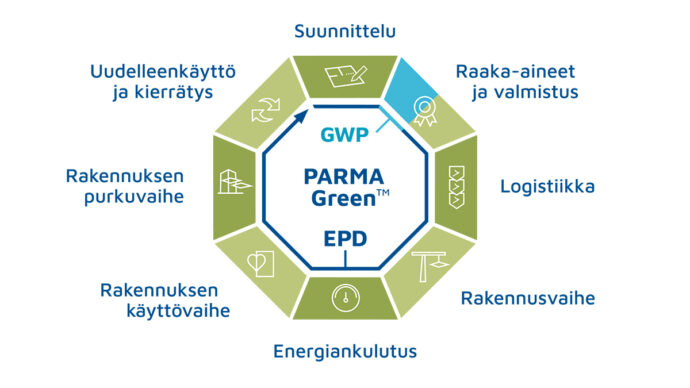
Environmental Product Declarations for Parma Products
The comparable and verified environmental impacts of Parma’s low-carbon products are presented in Environmental Product Declarations (EPDs) based on life cycle assessments. These Environmental Product Declarations are a voluntary and standardized way to reliably describe key information about a product’s environmental impacts. Environmental Product Declarations help building contractors, developers, and designers assess the environmental impacts of building products and materials.
The information in the RTS-EPD environmental declarations published by the Building Information Foundation is presented in accordance with the EN 15804 standard. This ensures the comparability of the data. All of Parma’s factories are EPD-certified.
The indicators in environmental product declarations describe the environmental impacts caused during a product’s life cycle, which include, among others:
- impacts on climate change
- ozone-depleting substances
- emissions that acidify soil and water bodies
- emissions causing eutrophication
- depletion of non-renewable energy resources and mineral flows
By far the most interesting indicator at present is carbon dioxide emissions (CO2-eq) that contribute to global warming. Emissions are reported per functional unit of the product, which may be, for example, kg, tn, m², or m³.