
The Concrete and Steel Alliance Boosts the Kotka Battery Materials Plant Project
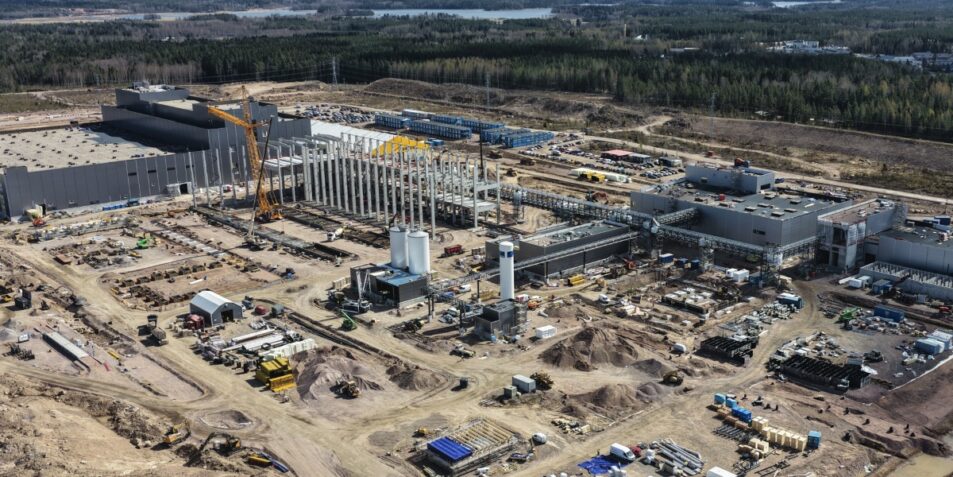
The battery materials plant currently under construction in Kotka represents an exceptionally large-scale project in Finnish industrial construction, in which concrete and steel form a precisely optimized whole. The Anstar steel components supplied by Consolis Parma—used for bracing, fastenings, joints, and installation of the massive precast concrete frame supplied by Consolis Parma contribute to the efficient and cost-effective execution of this major industrial project within a tight schedule.
The battery materials plant currently under construction in Kotka, with a total investment of approximately 800 million euros, is one of the most significant industrial construction projects in Finland in recent years. In terms of scale, it is on par with traditional forest industry plants. The main process building measures approximately 140 × 140 meters and is about 30 meters at its highest point, and the complex includes several production and auxiliary buildings.
The battery materials plant, which produces cathode active material for lithium-ion batteries, is being built by the Sino-Finnish company Easpring Finland New Materials. The general contractor is China Harbor Engineering Company Ltd (Finnish branch). The project will employ up to 800 people during construction and, once production begins in 2027, will directly employ approximately 270 people.
Pertti Koivumaanaho of Sweco Finland Oy, who is responsible for structural design, explains that the site’s structural framework is based on a clear division of labor among materials.
“The project primarily features a precast concrete frame. Anstar’s bracing systems and truss connectors have been used for the bracing,” Koivumaanaho explains.
In addition to concrete elements, Anstar has also supplied Parma with a wide range of other steel components for the project, such as fasteners, connectors, and column bases.
The building’s intermediate floors are constructed using hollow-core slabs and in-situ concrete, and the span lengths are longer than those typical in industrial construction. At the same time, the load levels are high.
“The factory has square loads of approximately 15 kilonewtons, as well as significant point loads from process equipment,” notes Pertti Koivumaanaho.
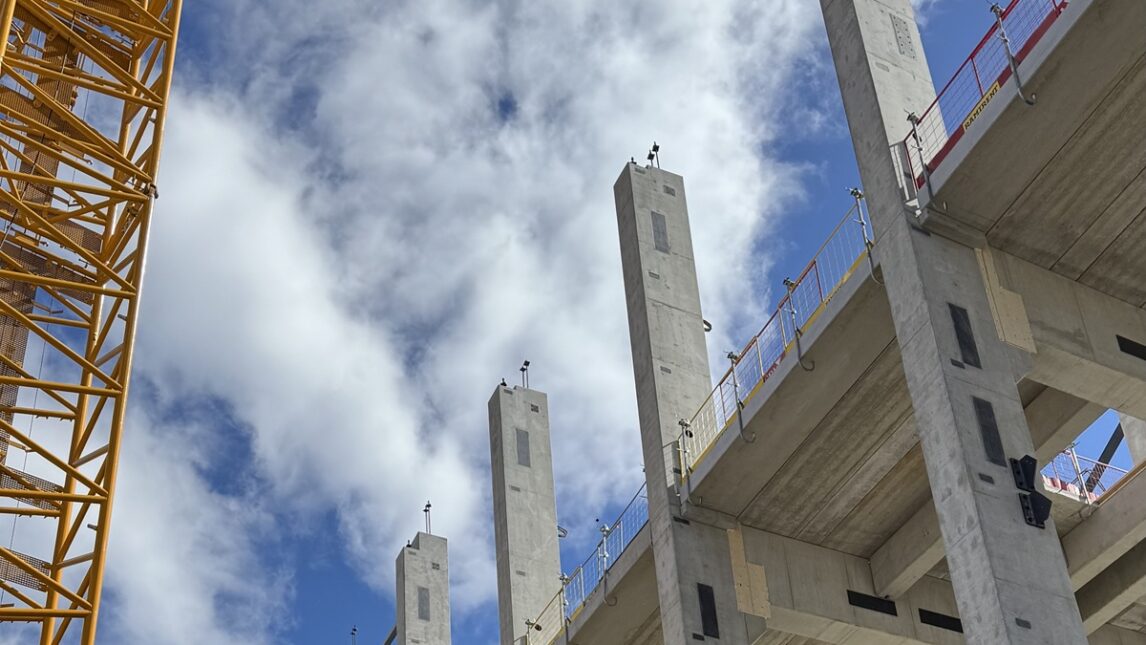
The scale of the project is illustrated by the fact the fact that the largest columns in the production building measure up to 900 × 900 millimeters and those in the warehouse as much as 1,350 × 800 mm, with maximum weights exceeding 60 metric tons.
Bracing and Fastening with Anstar Steel Components
The overall structural system is based on a combination of concrete and steel. Concrete serves as the load-bearing framework, particularly due to fire resistance requirements and heavy loads, while steel is used in supplementary structures.
“Steel has been used in the sheet-insulation-sheet elements of the facades and interior walls, as wind columns, and in various smaller structures,” Koivumaanaho explains.
Ruukki Construction has supplied the sandwich panels for the facades of the buildings at the Kotka battery materials plant, as well as lightweight EI-M fire wall solutions.
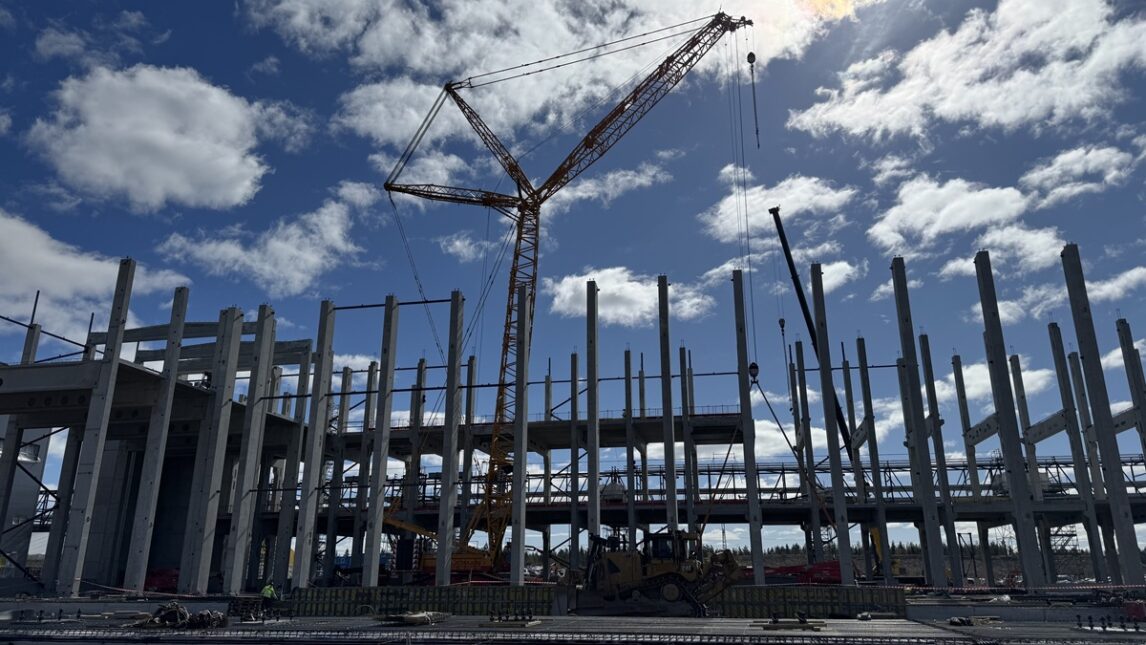
Multi-level beam system and concealed fasteners
The scale of the fastening components is also exceptional. The building uses large fastening plates and heavy-duty connectors that meet industrial-scale requirements.
“When you see them on site, they really give you the impression that the structure is reliable and functional,” says Koivumaanaho.
The building’s frame consists of several overlapping beam levels. The system formed by primary, secondary, and tertiary beams allows for the penetrations and space reservations required by the process equipment.
Anstar’s concealed bracket solutions are also utilized in these connections.
“When a secondary beam connects to a main beam, an AEP concealed bracket is used. These are among the most robust in terms of load-bearing capacity,” explains Koivumaanaho.
These solutions facilitate both precast production and installation, particularly in complex connection scenarios.
Coordination of Concrete and Steel Is Key
Parma Oy is responsible for the delivery of the concrete elements, including element design and wet installation. The company’s sales manager, Markku Rotko, describes the project as exceptional in scale.
“The production building contains approximately 5,700 concrete elements. Individual columns can weigh up to 60 metric tons, and beams can weigh tens of metric tons,” says Markku Rotko.
The weight of the structures is also evident in the connection components.
“Bolts as large as 60 millimeters have been used in the column bases. I don’t recall ever encountering solutions of this size before,” he says.
Anstar’s components were selected based on our partnership and proven solutions, and, of course, the price had to be competitive as well.
“Anstar has been our regular partner, and their solutions have proven effective in these projects,” Rotko notes.
A key aspect of the design has been the coordination of concrete elements and steel components. The structural design produced by Sweco serves as the starting point, based on which Parma carries out the element design.
“Sweco creates the information model, and we produce our own element model based on it. This ensures compatibility,” Rotko explains.
The supply chain between Anstar, Parma, and the construction site has been tight, even though schedule pressures have presented challenges.
“The biggest challenge has been that detailed specifications are received late. Since the components are heavy, we can’t stockpile large quantities of them in advance,” Markku Rotko notes.
Smooth Installation Speeds Up a Major Project
Both Koivumaanaho and Rotko emphasize the importance of steel components for the efficiency of the installation.
“The bracing fasteners are extremely effective for installation. Without them, erecting the frame would be considerably more difficult,” says Rotko.
Koivumaanaho also sees ease of installation as a key advantage.
“Stability during installation has already been factored into the system. This significantly speeds up the on-site phase,” he notes.
The Kotka project is complemented by Fazer’s new chocolate factory in Lahti, for which Parma is also supplying precast concrete elements. Anstar’s steel components are also being used in Lahti.
“Although the Lahti factory is also a large construction project, it is about one-tenth the size of the Kotka project. There, the roof—which is primarily a steel truss structure—will rest on columns, and there won’t be multi-level intermediate floors in the same way,” Rotko explains.
The battery materials plant in Kotka demonstrates how the combination of concrete and steel structures can be used to build highly demanding industrial facilities. Concrete provides mass, load-bearing capacity, and fire resistance to the structure, while steel enables effective bracing, connections, and smooth installation.
“Once the solutions are finalized, the structural design itself is ultimately quite straightforward. The biggest challenge is coordinating all parties and systems,” Koivumaanaho summarizes.
This article was previously published in its entirety in the Teräsrakenne 1/2026 issue.