
Fewer Emissions from Concrete Structures – In Jätkäsaari’s Circular Economy District, Low-Carbon Design Extends from Intermediate Floors to Facades
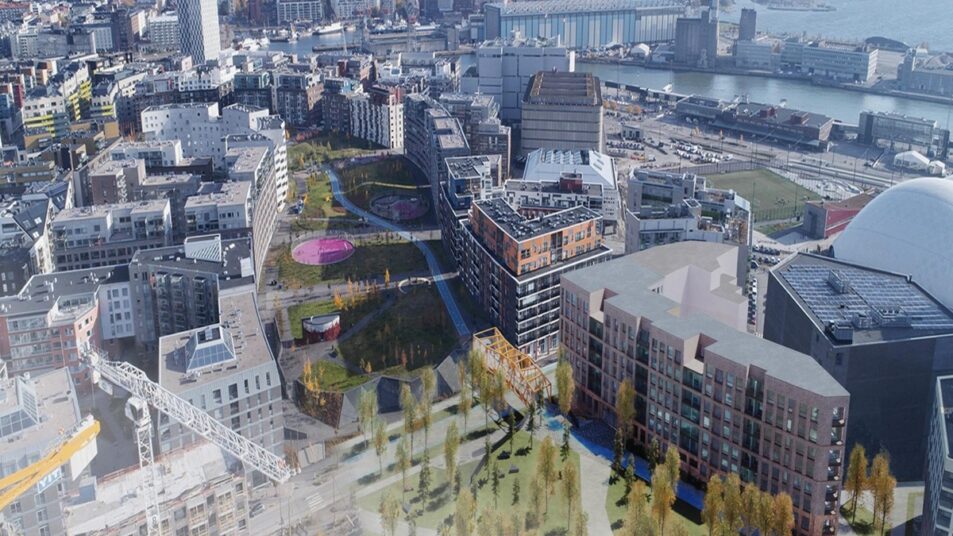
Yrjö and Hanna Kotien’s Circular Economy Block, currently under construction in Jätkäsaari, Helsinki, is exploring ways to reduce construction emissions in various parts of the building, from the foundations to the facades. One significant aspect is the concrete elements used in the building.
The Circular Economy Block will utilize Consolis Parma’s low-carbon PARMA Green™ elements in floor slabs, interior walls, and a new type of PARMA plaster block element solution used on the courtyard facade.
These solutions illustrate two ways to reduce the environmental impact of concrete construction: by lowering emissions from concrete production and by developing structures that use the material as efficiently as possible.
Lower-carbon concrete in over 2,000 elements
Concrete is used extensively in apartment building construction, so reducing emissions from its production can significantly impact a construction project’s carbon footprint.
The circular economy block will feature approximately 1,400 hollow-core and shell slabs, 600 partition wall elements, and 150 solid floor slab elements. There are about a hundred PARMArappausblock facade elements at the site. In total, this amounts to over 2,000 elements. The concrete used in them is manufactured to the BY Low-Carbon Class GWP.85®.
GWP.85 means that carbon dioxide emissions from concrete production are at least 15 percent lower than the reference level used in the classification.
Emissions from PARMA Green™ products can be reduced, for example, through the use of lower-carbon concrete mixes, optimization of raw material usage, recycled materials, and carbon-efficient design solutions. Depending on the product, carbon dioxide emissions can be up to 60 percent lower than those of a comparable standard product.
In the circular economy district, the use of lower-carbon concrete is not limited to a single pilot project; rather, the solution extends to a large portion of the building’s structural elements.
Emissions reductions must also be verifiable
As low-carbon materials become more widespread, reliable and comparable information on their environmental impacts is needed. The environmental impacts of PARMA Green™ products are documented in EPDs (Environmental Product Declaration), which are based on an assessment of the product’s life-cycle environmental impacts, or the concrete used in the products’ manufacturing meets at least the BY Low-Carbon Class GWP.85 requirements.
With the help of standardized and verified environmental declarations, developers, designers, and contractors can assess the environmental impacts of building products and use this information to calculate a building’s carbon footprint.
The importance of verifiable data is also growing as requirements for environmental claims become stricter. Simply calling a product “low-carbon” is not enough; reliable data is needed to support environmental claims.
Simply calling a product “low-carbon” is not enough; reliable data is needed to support environmental claims.
A New Type of Structure on the Courtyard Facade
The courtyard facade takes a fresh approach to emissions and material use.
The circular economy block utilizes the PARMA plaster block solution, jointly developed by Consolis Parma and Lammin Betoni. In this solution, the plaster base, thermal insulation, and concrete structure are combined into a factory-manufactured exterior wall element.
The solution is based on the Lammi Kuorikivi® blocks developed by Lammin Betoni. These blocks are placed in molds at Parma’s factory and cast as part of the wall element. BY-Low-Carbon Class GWP.85® concrete is used in the inner shells of the facade elements. The elements are manufactured at Parma’s Nastola plant, after which the final plastering of the facade is done on-site.
In the circular economy block, this solution was considered as an alternative to a traditional facade built with fired bricks.
Part of the plastered facade is located above the parking garage, so a lighter wall structure is beneficial for the project: it reduces the load on the structures below.
The zoning plan also influenced the decision
The facade solution could not be chosen solely on the basis of emissions, material quantity, or costs. The zoning plan for the Circular Economy Block also sets requirements for facade materials.
According to the plan, facades must primarily be masonry built on-site or plastered over a masonry surface. This ruled out, for example, large panel surfaces as options.
The PARMA plaster block was interpreted by the building control authority as a facade solution compliant with the plan. The solution thus made it possible to combine the plan’s requirements with the project’s goals related to low-carbon construction and structural design.
Low-carbon construction is built on many choices
In the Circular Economy Block, low-carbon construction is not based on a single material or product. For different parts of the building, suitable solutions are sought to reduce the environmental impacts of construction.
For concrete elements, this means using low-carbon concrete in a large number of the building’s structural elements. In the facade, emissions can also be influenced through the structure and the amount of material used. At the same time, reliable and comparable information on the environmental impacts of these choices is needed.
In the Circular Economy Block, solutions are put into practice through collaboration between the client, designers, contractor, and material suppliers. In the block developed by Yrjö and Hanna Kotien and constructed by YIT, the PARMA Green™ and PARMArappausblock elements are one example of how low-carbon construction can be promoted in different parts of the building.
The underlying principle of the circular economy block is that the environmental impacts of construction cannot be addressed by a single material choice. The whole is made up of numerous choices made from the design phase through to construction.
In the Circular Economy District, low-carbon practices are not based on a single material or product. The whole is made up of numerous choices made throughout the process, from design to construction.